Waterproof Luxury Vinyl Plank & Tile Installation in Rockville, Silver Spring & the DMV
Rigid-core LVP and LVT installed flat, tight and gap-free across Rockville, Potomac, Bethesda & the DMV — basements, kitchens, baths and rental turnovers.
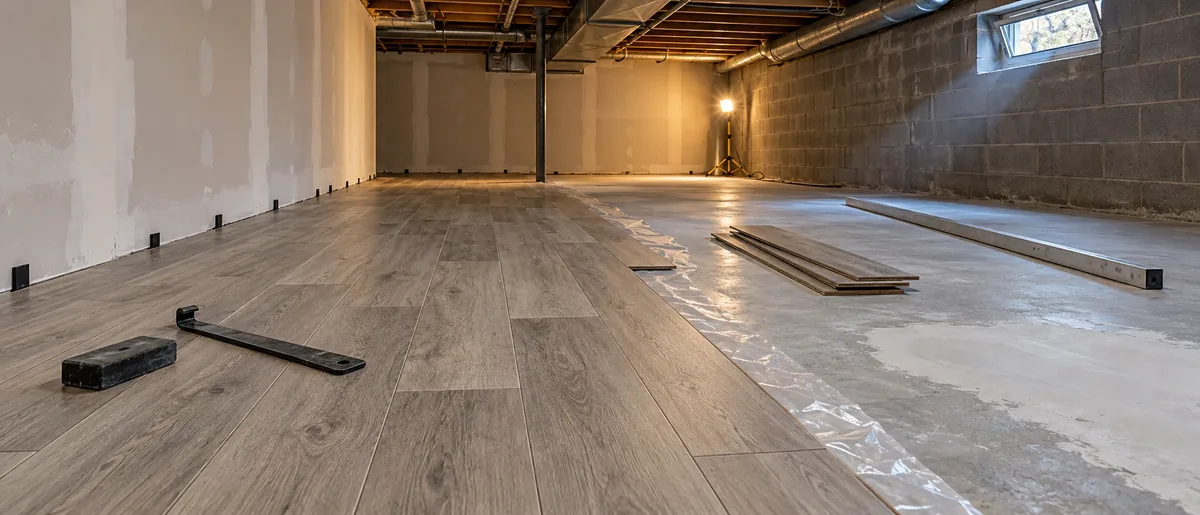
NextDayJose installs waterproof luxury vinyl plank and luxury vinyl tile across Rockville, Silver Spring, Potomac, Bethesda and Gaithersburg — basements, kitchens, baths, laundry rooms, whole main levels and rental turnovers. We handle the full job: tearing out the old floor, flattening and prepping the subfloor, laying the plank, and setting the transitions, stair nosing and baseboard back properly. Locally-owned, licensed and insured, 13+ years in DMV homes.
LVP has become the default floor in this market for one honest reason: it is the only finish floor that genuinely does not care about water. A rigid core will not swell at the seams the way laminate does or crack the way tile does over a moving slab. The catch is that it shows every flaw underneath it, so a vinyl plank job is won or lost on subfloor prep.
LVP & LVT Work We Do
- SPC & WPC rigid-core luxury vinyl plank
- Click-lock floating installation
- Full-spread glue-down LVP & LVT
- Luxury vinyl tile in stone & tile formats
- Groutable LVT for a real tile look
- Basement & below-grade slab floors
- Kitchen, bath, laundry & mudroom floors
- Whole-level installs & rental turnovers
- Old floor tear-out & haul-away
- Self-leveling, subfloor repair & moisture barrier
- Stair treads, nosing & landings
- Transitions, thresholds & baseboard reinstall
SPC vs. WPC: Which Rigid Core Belongs in Your Room
Nearly all quality LVP sold today is rigid-core, and it comes in two families. Knowing which one you are buying matters more than the brand name on the box.
| Core | What It Is | Where We Use It |
|---|---|---|
| SPC (stone polymer composite) | Dense limestone-and-PVC core, thinner and harder | Basements and slabs, rooms with big temperature swings, sunrooms, anywhere rolling loads or heavy furniture sit. Most dimensionally stable. |
| WPC (wood polymer composite) | Foamed composite core, thicker and lighter | Upstairs bedrooms and living areas where comfort and sound matter — warmer and softer underfoot, more forgiving over a slightly uneven wood subfloor. |
| Flexible glue-down LVP/LVT | Thin solid vinyl, no rigid core, bonded to the floor | Full baths, laundry rooms, commercial-traffic areas, large open spans, and over radiant heat. Nothing to float, so nothing to gap. |
If you want the floor to look like tile rather than wood, that is LVT — the same material in a square or rectangular tile format, including groutable versions that take real grout between tiles. It reads convincingly as stone at a fraction of the weight and cost, and it is warm underfoot in a way porcelain tile never will be.
Wear Layer: The Only Spec That Decides How Long It Lasts
Thickness gets advertised; wear layer is what matters. It is the clear protective top layer, measured in mils, and it is the difference between a floor that looks new in eight years and one that is scuffed grey in two.
- 6 mil — builder and big-box promotional grade. We steer homeowners away from it.
- 12 mil — the sensible floor for a normal owner-occupied home.
- 20 mil — what we put in rentals, homes with large dogs, and busy entries.
- 28 mil and up — short-term rentals and commercial traffic.
The upcharge from 12 mil to 20 mil is usually a dollar or two per square foot of material. On a rental make-ready that is the cheapest decision in the whole project, because the floor has to survive move-ins rather than one careful owner. It is the same calculation we walk through for landlords in our DC rent-ready turnover guide.
How We Install Luxury Vinyl Plank
We start by pulling the old floor and getting to a sound subfloor, fixing soft spots, squeaks and loose panels. Then we check flatness with a 10-foot straightedge — floating plank needs roughly 3/16" in 10 feet, and anything worse telegraphs through as hollow, clicking spots. High spots in plywood get sanded; dips get filled; a bad slab gets self-leveling compound and a cure day before anything goes down.
On concrete we check for moisture first and run a vapor retarder where the slab needs one — skipping that step is how a basement floor ends up with cupped, musty edges two summers later. Plank gets racked out so seams stagger properly and no end joint lands within six inches of its neighbor, which is both a strength and an appearance issue. We leave a consistent expansion gap at every wall, pipe and column, and we never trap a floating floor under a cabinet toe-kick or a door jamb.
The finish details are where most DIY and low-bid jobs fall apart: doors undercut rather than scribed around, a proper stair nosing instead of caulked-down bullnose, T-moldings only where a real break is needed, and baseboard or quarter round reinstalled to hide the expansion gap without pinching the plank. We reset the toilet with a new wax ring and the correct flange height if a bathroom floor changed height — see threshold replacement for the doorway side of that work.
Waterproof Plank vs. Waterproof Floor — The Distinction That Matters
This is the single most oversold thing in flooring, so it is worth being precise. An SPC or WPC plank is genuinely waterproof: submerge it and nothing happens. But on a floating installation, water on the surface still finds the seams and sits on the subfloor underneath, where it can do everything water normally does.
So the plank is not the whole answer. In a full bath, a laundry room, or a basement that has taken water before, we either glue the floor down or seal the perimeter so spills cannot get beneath it. In a kitchen or a living area, a floating floor is fine and a dishwasher leak gets caught in time. If you have already had water, our post-leak repair checklist covers what to look at before anything new goes down — putting a beautiful floor over a wet subfloor only hides the problem.
LVP in DMV Homes: Basements, Clay Soil & Humidity
Three local realities drive almost every vinyl plank job we quote in Montgomery County.
Basements. Rockville, Silver Spring and Bethesda basements sit on slabs that move with the region's clay soil and freeze-thaw cycles, and they run humid every July. That combination is brutal on carpet and on any wood-core floor. A rigid-core LVP over a prepped slab is the floor we install more than any other below grade, and it is the reason finished basements here have largely stopped using laminate.
Older framing. The 1950s ramblers and Cape Cods around Rockville, and DC and Takoma Park rowhouses, often have plank subfloors or 2x8 joists with real deflection. Vinyl plank tolerates more movement than tile does, which is why it is frequently the right answer in a house where ceramic tile would crack — but a bouncy floor still needs blocking or a plywood overlay first.
Sun and sliders. South-facing rooms and anything behind a big slider get real heat gain. Rigid core handles it, but the expansion gap has to be right or you get a buckled seam in August. We size gaps for the actual room, not by habit.
If you are prepping a unit to rent or sell, vinyl plank is also the fastest floor to turn over — no cure time, walkable immediately. We pair it constantly with move-out repairs, minor flooring repair on the rooms that do not need replacing, and home inspection repairs when a floor shows up on a report.
Luxury Vinyl Plank Installation Cost in Rockville & Silver Spring, MD
LVP and LVT are priced per square foot of labor, plus prep. Plank is usually supplied by you; we can source it at cost:
| Service | Estimated Cost | Notes |
|---|---|---|
| Floating click-lock LVP | $3 – $6 / sq ft | Labor; plank supplied by you |
| Glue-down LVP or LVT | $4 – $8 / sq ft | Adhesive included; best for wet rooms |
| Groutable LVT | $6 – $10 / sq ft | Grout joints, longer install |
| Small room (under 120 sq ft) | $450 – $900 | Minimum job charge applies |
| Old floor tear-out & haul-away | $1 – $3 / sq ft | Glued tile or mortar bed costs more |
| Self-leveling compound | $250 – $1,200 | Depends on area and depth; adds a cure day |
| Plywood overlay or subfloor repair | $300 – $1,400 | Soft spots, squeaks, bounce |
| Slab moisture barrier | $0.50 – $1.50 / sq ft | Below-grade and on-grade slabs |
| Stair treads & nosing | $60 – $120 / tread | Matching plank-wrapped treads |
| Transitions, T-mold & thresholds | $8 – $18 / linear ft | Room-to-room and doorway breaks |
| Quarter round or baseboard reinstall | $2 – $5 / linear ft | New shoe molding priced separately |
| Furniture moving & appliance pull | $100 – $350 | Per room; disconnects by others |
*Prices are estimates for the Rockville, Silver Spring, Potomac, and greater DMV area. Final cost depends on materials and scope of work. Request a free estimate — we never charge for quotes.
Choosing Between LVP, Waterproof Laminate & Tile
We install all three and we will tell you plainly which one fits the room rather than which one we would rather sell.
- Below grade, full baths, laundry: luxury vinyl plank, every time.
- Above-grade living areas where the wood look matters most: waterproof laminate — harder surface, more realistic grain, firmer underfoot.
- Entries, mudrooms, wet rooms and anywhere you want real stone or tile: porcelain tile, or ceramic tile for baths and kitchens.
- Fastest rental turnover with the least risk: 20-mil LVP.
Luxury Vinyl Plank FAQs — Rockville, Potomac & Silver Spring
How much does luxury vinyl plank installation cost in Rockville?
Labor for floating click-lock LVP runs about $3 to $6 per square foot in the Rockville and Silver Spring area, and $4 to $8 per square foot for glue-down LVT. Tear-out of the old floor, self-leveling and subfloor repair are added on top. A 200 square foot basement room typically lands between $1,100 and $2,200 for labor, with the plank supplied by you. Quotes are always free.
Is luxury vinyl plank really waterproof in a basement?
The plank itself is. An SPC or WPC rigid core will not swell, buckle or delaminate if it gets wet, which is why it is the floor we recommend most for Montgomery County basements. But a waterproof plank is not the same as a waterproof floor: on a floating installation water still travels down through the seams and sits on the slab. For a basement that has taken water before, or a full bath, we either glue the floor down or run a sealed perimeter so spills cannot get underneath.
What is the difference between LVP and waterproof laminate?
LVP has a plastic core, usually stone-polymer or wood-polymer composite, so water does nothing to it at all. Waterproof laminate has a wood-fiber core with a sealed surface and treated edges, which handles spills and mopping but is still a wood product underneath. For below-grade rooms, full baths and laundry rooms we use LVP. For above-grade living areas where the most realistic wood look matters, waterproof laminate is often the better floor and usually feels more solid underfoot.
Can you install vinyl plank over existing tile or vinyl?
Often, yes, and it saves real money on tear-out. The existing floor has to be well bonded, flat and not cushioned. Over ceramic tile we skim the grout lines flat first, because a floating plank will telegraph every joint within a year. We will not float over carpet, over a cushioned-back sheet vinyl, or over any floor that flexes underfoot. Adding height also affects doors, appliances and transitions, so we check those before recommending it.
What wear layer should I choose for a rental?
Wear layer is measured in mils and it is the single number that decides how long the floor lasts. Six mil is builder-grade and we steer clients away from it. Twelve mil holds up in a normal family home. For a rental unit, a short-term rental or a house with large dogs, 20 mil or more is worth the small upcharge, because the floor has to survive move-ins rather than one careful owner.
How long does a vinyl plank floor take to install?
Most rooms are a one-day job once the subfloor is sound. A 200 to 400 square foot room with simple tear-out is typically a single day, and a main level of 800 square feet or more runs two to three days. Self-leveling adds a day because the compound has to cure before plank goes down. Unlike tile, there is no grout cure, so the floor is walkable the moment we finish.
Why Rockville Homeowners Choose NextDayJose
Get a Free LVP Installation Quote in Rockville
Fill out the form and we'll respond within 30 seconds!