Handyman Porcelain Tile Installation in Rockville, Silver Spring & the DMV
Large-format, rectified and wood-look plank porcelain set flat and lippage-free across Rockville, Potomac, Bethesda & the DMV — basements, entries, mudrooms and baths.
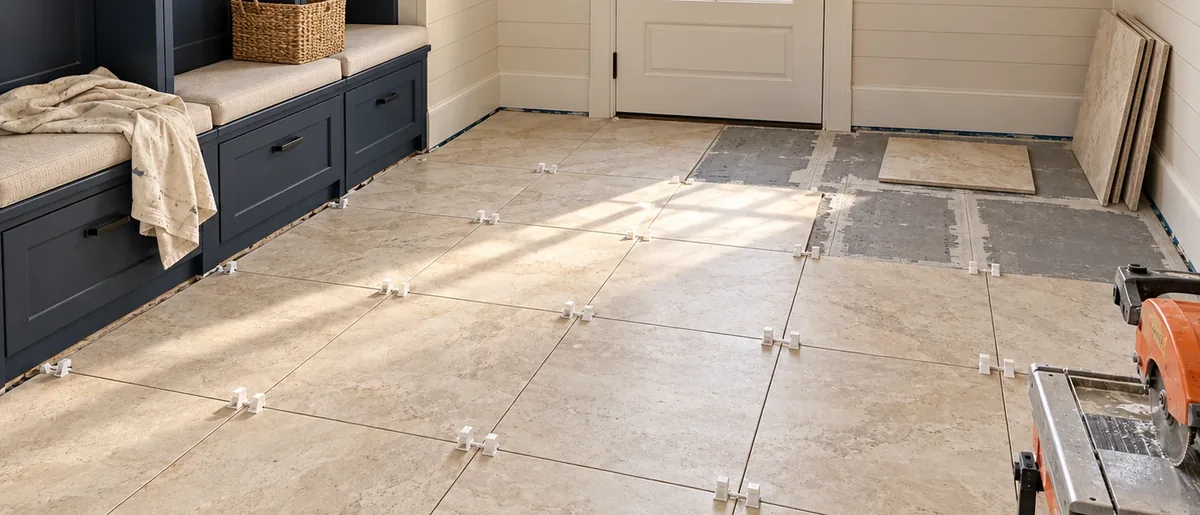
NextDayJose installs porcelain tile floors across Rockville, Silver Spring, Potomac, Bethesda and Gaithersburg — basement floors, entries and foyers, mudrooms, laundry rooms, kitchens and bathrooms. We do the whole job: tear-out and haul-away, subfloor flattening, membrane or backer board, setting the tile in the correct mortar, grouting, sealing, and resetting baseboard, thresholds and the toilet. Locally-owned, licensed and insured, 13+ years in DMV homes.
Porcelain is the toughest tile you can put on a residential floor: pressed denser and fired hotter than ceramic, under 0.5% water absorption, and hard enough that it shrugs off the entries and mudrooms that wreck other floors. It is also the least forgiving material we install. It will not flex over a dip, and the bigger the tile, the more ruthlessly it reports every flaw in the subfloor. That is why this page is mostly about preparation.
Porcelain Tile Work We Do
- Large-format porcelain (12×24, 24×24, 24×48)
- Rectified-edge porcelain with tight grout joints
- Wood-look porcelain plank tile
- Through-body & color-body porcelain
- Stone-look & concrete-look porcelain
- Basement & on-slab floors
- Entry, foyer & mudroom floors
- Kitchen, bath & laundry floors
- Covered porches & freeze-prone surfaces
- Old floor tear-out & haul-away
- Self-leveling, backer board & uncoupling membrane
- Leveling-clip systems for flush edges
- Grout, sealing, movement joints & transitions
Why Porcelain Instead of Ceramic
They are both fired clay, and for a straightforward bathroom or kitchen floor ceramic tile installation is easier to cut, cheaper and perfectly good. Porcelain earns its premium in specific rooms:
- Basements and slabs — near-zero absorption, unaffected by humidity
- Entries and mudrooms — survives grit, salt and winter slush
- Anywhere that freezes — covered porches, garage steps, unheated spaces
- High-traffic kitchens — through-body porcelain hides a chip because the color runs all the way through
- Large tile and plank looks — porcelain is what those formats are made in
The trade-offs are real too: it is heavier, it needs a diamond blade and a wet saw rather than a snap cutter, and it is cold and hard underfoot. If you want warmth and quiet in a basement rec room, luxury vinyl plank is often the better call, and for a wood look on a main level we would point you at waterproof laminate.
Large-Format Porcelain: Where Tile Jobs Go Wrong
Most of the failed tile we are called in to look at is large-format, and the cause is nearly always the same: it was installed like small tile.
Once a tile has a side longer than about 15 inches, it has essentially no ability to conform to the floor beneath it. A dip that 12×12 ceramic would bridge becomes either a hollow spot you can hear underfoot or a lippage edge you can feel with a bare toe. The flatness standard tightens as the tile grows, so the prep is the job.
Here is what large-format actually requires, all of which we do as standard:
- A flatter substrate — checked with a 10-foot straightedge, ground down or self-leveled until it meets spec, not eyeballed
- LFT mortar — a large-and-heavy-tile mortar that holds its notch without slumping under the weight
- Back-buttering — mortar on the tile as well as the floor, for the near-full coverage big tile needs; voids under a corner are where cracks start
- A leveling clip system — holds adjacent edges flush while the mortar cures, which is the only reliable way to control lippage
- Correct joint width — rectified tile can take a tight 1/16" to 1/8" joint; non-rectified tile cannot, and forcing it shows every size variation
- Movement joints — soft joints at the perimeter and at changes of plane, never grout tight to the wall
Wood-look porcelain plank adds one more rule. Long plank tile comes out of the kiln with a slight lengthwise bow, so the offset has to stay near one third — a brick-style half offset puts the high middle of one plank against the low end of the next and guarantees lippage down the whole run. We lay plank at a 1/3 offset and clip every joint.
How We Install a Porcelain Tile Floor
We pull the old floor down to the subfloor, fix soft or squeaky spots, and check deflection and flatness before anything else. Over wood framing we add plywood or blocking where the joists are bouncy, then screw down cement backer board or install an uncoupling membrane such as Schluter DITRA. Over concrete we grind the high spots, fill the low ones with self-leveling compound, and bridge existing slab cracks with membrane so they cannot telegraph up into the tile.
Tile gets set in the right mortar for its size, combed in one direction with a properly sized notched trowel and back-buttered, so there are no voids. Large-format and plank go down with leveling clips. We dry-lay the layout first to center the pattern and avoid a sliver cut at the most visible wall — and in a bathroom that means planning around the toilet flange and the vanity, not starting in a corner and hoping.
After the mortar cures we grout, sponge, and install soft movement joints at the perimeter and at any doorway or plane change. Cement grout gets sealed. Then baseboard goes back, thresholds get set to the neighboring floor height, and the toilet is reset with a new wax ring and the correct flange height for the new floor thickness. Wall tile around the same room is backsplash work, and if the walls took damage during tear-out we handle drywall repair in the same visit.
Porcelain Tile in DMV Homes: Slabs, Clay Soil & Old Joists
Two local conditions explain most of the cracked tile we see around Rockville, Bethesda and Silver Spring.
Slabs that move. Montgomery County sits on clay soil that swells and shrinks with moisture, and our freeze-thaw cycles work on it all winter. Basement and on-grade slabs here develop hairline cracks as a matter of course. Tile bonded directly to a cracking slab cracks with it, which is why we use an uncoupling membrane on slab work rather than treating it as optional — it lets the slab move underneath without taking the floor with it.
Older framing. The 1950s ramblers and Cape Cods around Rockville, and the DC and Takoma Park rowhouses, frequently have 2x8 joists, long spans or plank subfloors with more deflection than tile tolerates. We check that before quoting, because no mortar or membrane makes up for a floor that flexes. Sometimes the right answer is stiffening the framing first; sometimes it is telling you that vinyl plank is the better floor for that room. We would rather say so up front than warranty a crack.
Cracked or hollow tile is also one of the most common items on a local home inspection report. We can usually swap a few tiles from attic stock rather than redoing the room — see home inspection repairs, or caulk and grout refresh when the tile is sound and only the joints look tired.
Porcelain Tile Installation Cost in Rockville & Silver Spring, MD
Porcelain is priced per square foot of labor, plus prep. Tile is usually supplied by you; we can source it at cost:
| Service | Estimated Cost | Notes |
|---|---|---|
| Porcelain floor tile, standard size | $10 – $16 / sq ft | Labor; tile supplied by you |
| Large-format porcelain (12×24 and up) | $12 – $20 / sq ft | LFT mortar & leveling clips included |
| Wood-look porcelain plank | $12 – $18 / sq ft | Offset limited to 1/3; every joint clipped |
| Rectified tile, tight grout joints | add $1 – $3 / sq ft | Less tolerance; slower layout |
| Diagonal or pattern layout | add $2 – $4 / sq ft | More cuts and waste |
| Small bathroom floor (under 50 sq ft) | $1,100 – $2,200 | Toilet pull & reset included |
| Old floor tear-out & haul-away | $2 – $5 / sq ft | Tile over a mortar bed costs more |
| Backer board or uncoupling membrane | $2 – $4 / sq ft | Required over wood; standard on slabs |
| Self-leveler or subfloor flattening | $250 – $1,400 | Depends on area and depth |
| Joist stiffening or plywood overlay | $400 – $1,600 | Where deflection exceeds tile tolerance |
| Grout sealing | $0.50 – $1.25 / sq ft | Cement grout; epoxy needs none |
| Movement joints & transitions | $10 – $22 / linear ft | Perimeter soft joints, metal edge profiles |
| Cracked tile replacement | $200 – $550 | Few tiles, from attic stock |
*Prices are estimates for the Rockville, Silver Spring, Potomac, and greater DMV area. Final cost depends on materials and scope of work. Request a free estimate — we never charge for quotes.
Porcelain Tile FAQs — Rockville, Potomac & Silver Spring
How much does porcelain tile installation cost in Rockville?
Labor for porcelain floor tile runs about $10 to $18 per square foot in the Rockville and Silver Spring area, with large-format and wood-look plank formats at the upper end because they need a leveling system and more layout care. Tear-out, uncoupling membrane and subfloor flattening are added on top. A small bathroom floor typically lands between $1,100 and $2,200 installed. Quotes are always free.
What is the difference between porcelain and ceramic tile?
Both are fired clay, but porcelain is pressed denser and fired hotter, so it absorbs less than 0.5 percent water and is much harder. That makes it the right choice for basements, entries, mudrooms, laundry rooms and any exterior or freeze-prone surface. It is also harder to cut and heavier to handle, which is part of why it costs more to install. For a straightforward bathroom or kitchen floor, ceramic is easier to work and perfectly good.
Why does large-format porcelain tile need special installation?
Anything with a side longer than 15 inches has almost no ability to flex, so a subfloor dip that ceramic would tolerate becomes a lippage edge or a hollow spot you can feel. Large-format tile needs a flatter substrate, a large-and-heavy-tile mortar that holds its thickness without slumping, back-buttering for full coverage, and a clip-style leveling system to hold adjacent edges flush while the mortar sets. Skipping any of those is why large tile jobs end up with ridges at the joints.
Can porcelain tile be installed in a basement or on a concrete slab?
Yes, and it is one of the best uses for it, because porcelain does not care about moisture the way a wood-core floor does. The slab has to be flat, clean and free of active moisture problems first. We grind high spots, fill low spots with self-leveler, bridge existing slab cracks with an uncoupling membrane, and leave proper movement joints at the perimeter instead of grouting tight to the wall. Montgomery County slabs move with clay soil and freeze-thaw cycles, so that detail is what keeps the floor from cracking later.
Is wood-look porcelain plank harder to install than regular tile?
Yes, noticeably. Plank-format porcelain is long and narrow, and most of it has a slight lengthwise bow from the kiln, so a running-bond layout has to be limited to about a one-third offset rather than a brick-style half offset. Any more and the bow shows up as lippage in the middle of every plank. It also needs back-buttering and leveling clips on every joint. The result looks like hardwood and survives water, which is why we install a lot of it in mudrooms and basements.
How long does a porcelain tile floor take?
A bathroom floor is usually two to three days: tear-out and prep, setting, then grouting once the mortar has cured. A kitchen, entry or basement typically runs three to five days, and large-format work can add a day because of the extra prep and leveling. You can generally walk on the tile after about 24 hours, with full cure in a few days before heavy furniture goes back.
Why Rockville Homeowners Choose NextDayJose
Get a Free Porcelain Tile Quote in Rockville
Fill out the form and we'll respond within 30 seconds!